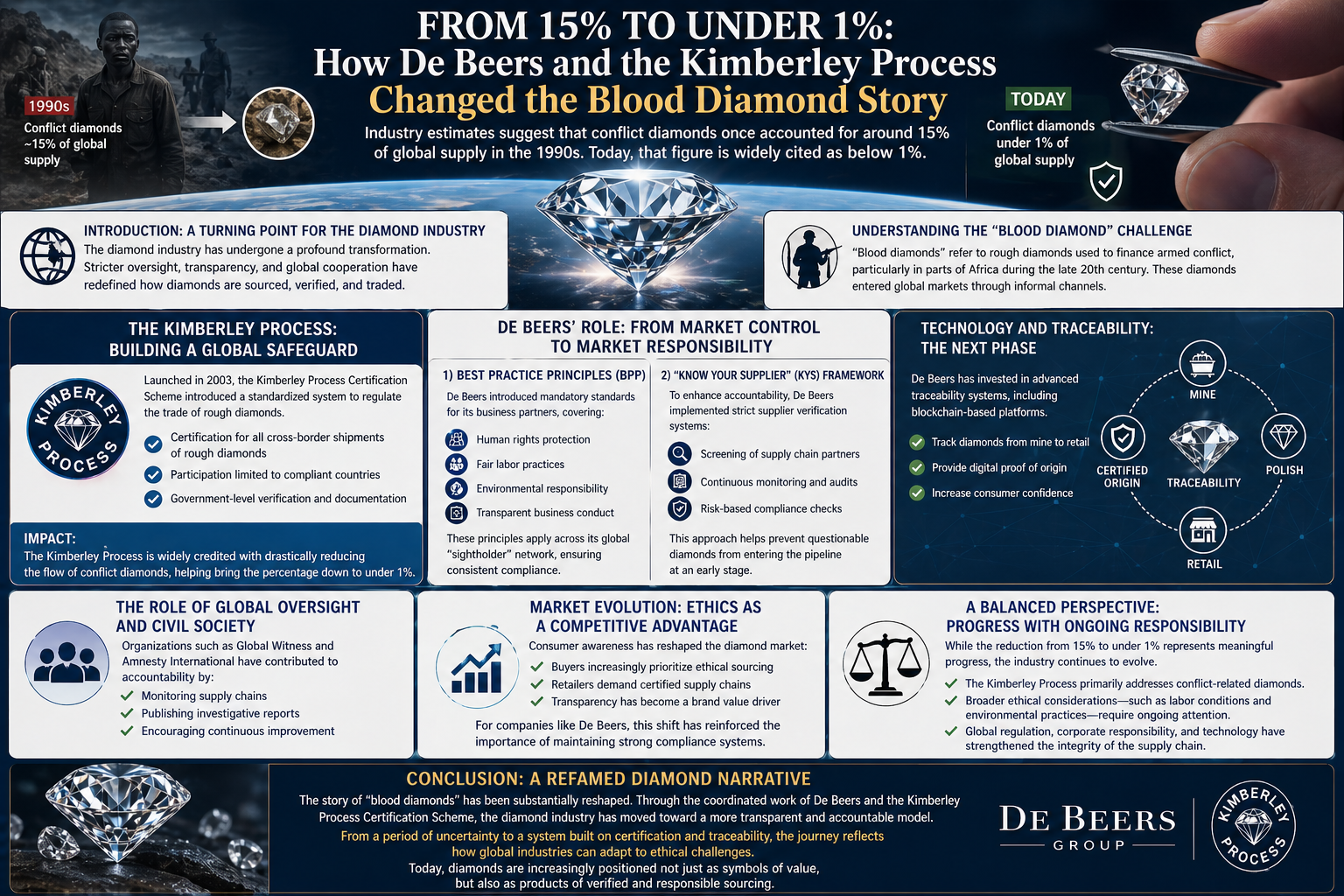
From 15% to Under 1%: How De Beers and the Kimberley Process Changed the Blood Diamond Story
Introduction: A Turning Point for the Diamond Industry
The global diamond industry has undergone a profound transformation over the past three decades. Once associated with the term “blood diamonds,” the sector today operates under far stricter oversight and transparency standards. Central to this shift are efforts by De Beers and the international framework known as the Kimberley Process Certification Scheme.
Industry estimates suggest that conflict diamonds once accounted for around 15% of global supply in the 1990s. Today, that figure is widely cited as below 1%, reflecting a significant structural change in how diamonds are sourced, verified, and traded.
Understanding the “Blood Diamond” Challenge
“Blood diamonds” refer to rough diamonds used to finance armed conflict, particularly in parts of Africa during the late 20th century. These diamonds entered global markets through informal channels, making it difficult for buyers to distinguish them from ethically sourced stones.
As awareness grew, governments, companies, and civil society organizations recognized the need for a coordinated global response.
The Kimberley Process: Building a Global Safeguard
Launched in 2003, the Kimberley Process Certification Scheme introduced a standardized system to regulate the trade of rough diamonds.
Key features include:
- Certification for all cross-border shipments of rough diamonds
- Participation limited to compliant countries
- Government-level verification and documentation
This framework created a closed-loop trading system, ensuring that diamonds without proper certification could not legally enter international markets.
Impact:
The Kimberley Process is widely credited with drastically reducing the flow of conflict diamonds, helping bring the percentage down to under 1%.
De Beers’ Role: From Market Control to Market Responsibility
As one of the most influential players in the diamond industry, De Beers has played a significant role in strengthening ethical sourcing practices.
1) Best Practice Principles (BPP)
De Beers introduced mandatory standards for its business partners, covering:
- Human rights protection
- Fair labor practices
- Environmental responsibility
- Transparent business conduct
These principles apply across its global “sightholder” network, ensuring consistent compliance.
2) “Know Your Supplier” (KYS) Framework
To enhance accountability, De Beers implemented strict supplier verification systems:
- Screening of supply chain partners
- Continuous monitoring and audits
- Risk-based compliance checks
This approach helps prevent questionable diamonds from entering the pipeline at an early stage.
Technology and Traceability: The Next Phase
Beyond regulatory compliance, De Beers has invested in advanced traceability systems, including blockchain-based platforms.
These technologies:
- Track diamonds from mine to retail
- Provide digital proof of origin
- Increase consumer confidence
This shift reflects a broader industry move toward data-driven transparency, aligning with modern buyer expectations.
The Role of Global Oversight and Civil Society
Organizations such as Global Witness and Amnesty International have contributed to accountability by:
- Monitoring supply chains
- Publishing investigative reports
- Encouraging continuous improvement
Their involvement has helped maintain pressure for higher standards across the industry.
Market Evolution: Ethics as a Competitive Advantage
Consumer awareness has reshaped the diamond market:
- Buyers increasingly prioritize ethical sourcing
- Retailers demand certified supply chains
- Transparency has become a brand value driver
For companies like De Beers, this shift has reinforced the importance of maintaining strong compliance systems and clear communication.
A Balanced Perspective: Progress with Ongoing Responsibility
While the reduction from 15% to under 1% represents meaningful progress, the industry continues to evolve. The Kimberley Process primarily addresses conflict-related diamonds, and broader ethical considerations—such as labor conditions and environmental practices—require ongoing attention.
However, the combined efforts of global regulation, corporate responsibility, and technological innovation have significantly strengthened the integrity of the diamond supply chain.
Conclusion: A Reframed Diamond Narrative
The story of “blood diamonds” has not disappeared, but it has been substantially reshaped. Through the coordinated work of De Beers and the Kimberley Process Certification Scheme, the diamond industry has moved toward a more transparent and accountable model.
From a period of uncertainty to a system built on certification and traceability, the journey reflects how global industries can adapt to ethical challenges. Today, diamonds are increasingly positioned not just as symbols of value, but also as products of verified and responsible sourcing.
Post a comment